
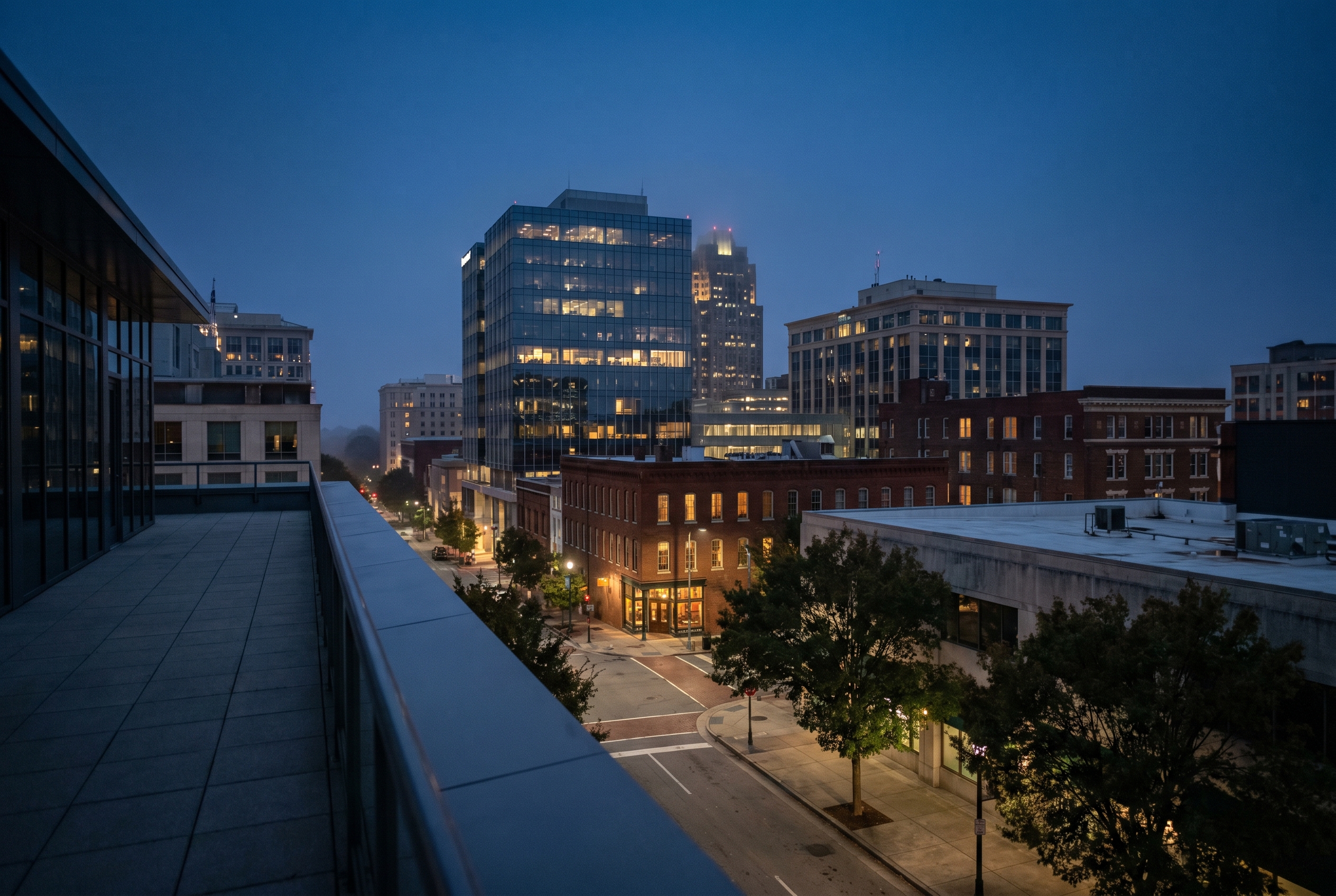
Most people don't associate Raleigh with AI. San Francisco, sure. New York, maybe. But the Research Triangle? It doesn't make the hype lists.
That's starting to change — quietly. Over the past 18 months, we've seen a sharp increase in AI-focused projects coming out of Raleigh, Durham, and the broader RTP corridor. Not from venture-funded AI labs, but from healthcare companies, fintech teams, and startups that need AI integrated into real products. Here's what's actually happening on the ground.
Why Raleigh Is Producing More AI Projects Than You'd Expect
The Triangle has three things that most AI hubs don't have in combination: research depth, domain expertise, and affordable operating costs.
Research talent is the foundation. NC State's computer science program ranks in the top 30 nationally, with dedicated AI and machine learning tracks. Duke's AI Health program is producing graduates who understand both the models and the clinical workflows. UNC's NLP research group has been publishing on language models since before GPT made them mainstream. That pipeline feeds directly into local companies.
Domain expertise is the differentiator. The Triangle isn't building AI for AI's sake. It's building AI for specific industries that already have deep local roots:
- Healthcare and biotech — RTP hosts the largest research park in North America. Companies like IQVIA, Biogen, and dozens of health-tech startups need AI for clinical trial optimization, patient monitoring, and diagnostic automation.
- Fintech and banking — Raleigh's proximity to Charlotte's banking corridor means fintech teams building fraud detection, risk scoring, and automated underwriting are common.
- AgTech and logistics — North Carolina is the ninth-largest agricultural state. AI-powered supply chain and precision agriculture tools are a growing niche.
Operating costs make it sustainable. A senior ML engineer in Raleigh costs 25-35% less than the same hire in the Bay Area. Office space in downtown Raleigh runs $25-30 per square foot compared to $65+ in San Francisco. For startups burning through runway, that math matters.
What "AI Software Development" Actually Means Here
When Raleigh-area companies come to us for AI development, they're rarely asking for a research project. They want production-ready AI features embedded in software their teams already use.
The most common patterns we see:
1. Adding AI capabilities to an existing app. A healthcare company with a patient portal wants to add intelligent triage — routing messages to the right care team based on symptom analysis. A logistics company wants predictive ETAs based on historical delivery data. These aren't moonshot projects. They're practical AI additions that cost $30K-$80K and ship in 8-12 weeks.
2. Building AI-native products from scratch. Early-stage teams in RTP are increasingly building products where AI is the core value proposition — not a feature bolted on later. We've scoped AI-native apps for clinical decision support, automated document review, and intelligent scheduling. The tech stack decisions for these products look different from traditional app builds.
3. Internal automation and agentic workflows. Mid-market companies in the Triangle are deploying AI agents to handle repetitive internal processes — invoice processing, compliance checking, customer support triage. This is the fastest-growing category. Teams that understand AI strategy before they start building get dramatically better results.
The Local vs. Remote Question
We've written about why Raleigh teams benefit from keeping development local, and that argument is even stronger for AI projects.
AI development has a higher communication overhead than traditional software. Model selection, training data decisions, accuracy thresholds, edge case handling — these require frequent, nuanced conversations between the development team and domain experts. When your AI developer is in the same timezone and can sit in the same room for a whiteboard session, the feedback loop compresses from days to hours.
This is especially true in regulated industries. If you're building HIPAA-compliant AI features for a Durham health-tech company, your development partner needs to understand both the technical constraints and the regulatory landscape. That's hard to outsource to a team 8,000 miles away.
What Triangle Founders Get Wrong About AI Development
After working with dozens of Triangle-area teams on AI projects, we see the same mistakes repeated:
Overscoping the first release. The most successful AI features start narrow. Don't try to build a general-purpose AI assistant — build a model that does one thing exceptionally well, prove the ROI, then expand. We've seen what happens when teams get AI in production wrong, and scope creep is the number one cause.
Underestimating data requirements. Every AI project is secretly a data project. If your training data is messy, incomplete, or biased, no amount of model tuning will save you. Budget 30-40% of your AI project timeline for data preparation and validation.
Treating AI development like traditional software estimation. Traditional apps have predictable timelines because the logic is deterministic. AI development includes experimentation — you might try three approaches before finding one that hits your accuracy threshold. Build that uncertainty into your timeline and budget from day one.
Skipping the build-vs-buy analysis. Not every AI feature needs a custom model. For image recognition, there are production-ready APIs that cost a fraction of a custom build. For natural language processing, fine-tuning an existing foundation model is almost always cheaper than training from scratch. A good AI development partner will tell you when off-the-shelf is the right call — even if it means a smaller project for them.
The Raleigh AI Opportunity Is Real — and It's Early
The Triangle is in a sweet spot right now. The talent is here. The industries that need AI are here. The cost structure makes it viable for startups and mid-market companies, not just enterprises with unlimited budgets.
But it's still early. Most Raleigh-area companies we talk to are in the "interested but haven't started" phase. The teams that move now — even with a focused, $30K-$50K first project — will have a meaningful head start over competitors who are still evaluating.
We work with Raleigh and RTP teams on AI strategy, scoping, and development. If you're exploring what AI could do for your product or operations, book a free strategy call and we'll help you figure out what's worth building first.